When you make a purchase through links on our site, we may earn an affiliate commission. As an Amazon Associate I earn from qualifying purchases.
Knowledge of the Future
By The Spinster Aunt
This seems like a fairly good time of year to be talking about divination. What is it, why do we do it, and what’s in it for us? Lots of people think it’s a way of avoiding responsibility – if the future is preordained, we might as well go back to bed. Of course, that’s not it at all.
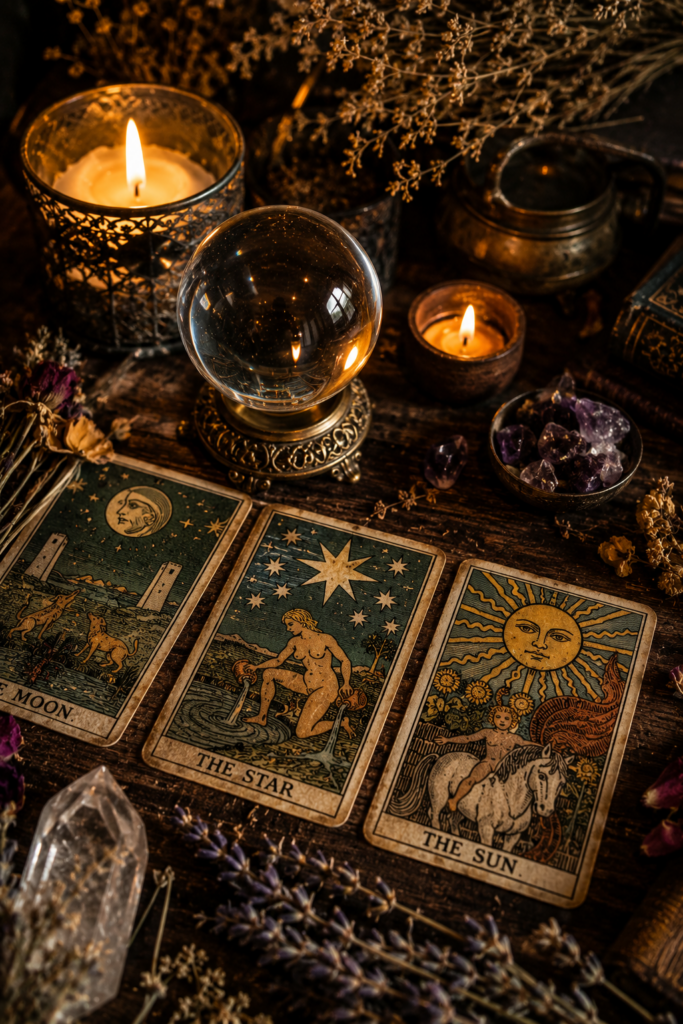
Divination is the use of any one of several methods to obtain information which is not directly accessible to the conscious mind of the person asking the question. Whether you use cards, crystals, a pendulum, ink, lead, dice, the flight of birds or anything else, what you are really doing is opening your end of a channel to higher wisdom.
I consider the “actual” source of that wisdom irrelevant and immaterial; it could be one’s own subconscious, the collective unconscious, the Gods’ will, telepathic insight, or a big computer buried in the Balkans. It’s still additional information which is not as tainted by ego and intellect’s limitations as most. So what do we do with it?
The same things we do with any other information; add it to what we already know and develop a synthesis that can help us do our decision-making. The easiest way to analyze the process is with a concrete (well, maybe jello) example: A young man has been between relationships for some time. He wants very much to link up with the great love of his life, but is not aware of anyone on the horizon.
He is putting himself in a position to meet new people, presenting himself as attractively as he can, and generally taking care of business, but no results. He has to decide whether to take a work related course at night or not. It will take a lot of time and there are not likely to be any women attending. His progressed horoscope is neutral. He gets his cards read. They say: [PAUSE]
1. Nothing at all about love, but a lot about skilled craftsmanship and satisfaction through work. He decides to relax and wait for a better time, takes the course, and is rewarded with a modest promotion which enhances his satisfaction with his job.
2. A lot about increasing social activities, leading to the start of a new romance, leading to great happiness and satisfaction after some difficulties are resolved. He does not take the course, and meets a really nice interesting lady at a party given by a friend (which he couldn’t have attended had he taken the course).
3. That he is overlooking sources of emotional gratification in his current situation. Given the information, he starts looking around and discovers that one of his quieter friends is a really thoughtful and insightful person who helps him learn to know himself better, and that a young cousin needs a mentor and this relationship gives him a lot of pleasure and fulfillment.
He begins to feel much more ready for a good relationship, and much less impatient to have one start. These examples illustrate the point made above; divination provides you with choices, and you take the consequences, no matter what the oracles say. Treat them with respect, not adoration or blind compliance, and may they always show you the truth.
✨ 5 Common Divination Methods & How They Work
If you want to clear mental noise before doing chart reads, try using a 2-minute sound ritual to center your focus.
Types of Divination Tools: Tarot, Pendulums, Runes & Scrying Explained
While there are dozens of ways to access intuitive guidance, four core methods stand out as the foundational pillars of modern divination practice:
1. Tarot Cards
A 78-card system rich with archetypal imagery, sacred geometry, and elemental symbolism. Tarot acts as a mirror to your current subconscious state, highlighting hidden dynamics and potential outcomes based on your present trajectory.
2. Pendulums
A weighted object suspended on a chain or string—often clear quartz, amethyst, or brass. By tapping into subtle nerve signals (ideomotor responses), a pendulum sways to give clear “yes,” “no,” or “maybe” answers to direct questions.
3. Elder Futhark Runes
An ancient Norse and Germanic system of 24 sacred alphabetic symbols carved into wood, stone, or bone. Each symbol carries a specific elemental power and ancestral wisdom, ideal for practical decision-making and energetic assessments.
4. Scrying (Crystal Balls, Water & Black Mirrors)
A meditative practice involving gazing into reflective or transparent media to quiet the conscious mind. As physical vision softens, internal intuitive pictures, visions, and symbolic messages begin to emerge.
Frequently Asked Questions About Divination
What is the main purpose of divination?
Divination is a practice used to gain insight, guidance, or hidden knowledge by connecting with the subconscious mind, intuition, or higher wisdom. Rather than predicting a fixed fate, it serves as a tool for self-reflection and decision-making.
What are the most common types of divination?
Popular methods of divination include tarot and oracle card readings, scrying (using crystal balls, mirrors, or water), runecasting, pendulum movement, palmistry, and astrology.
Can anyone practice divination, or do you need special abilities?
Anyone can learn and practice divination. While natural intuition helps, interpreting tools like cards, runes, or symbols is a skill developed through patience, study, and regular practice.
Integrating Divination into Mindful Daily Living
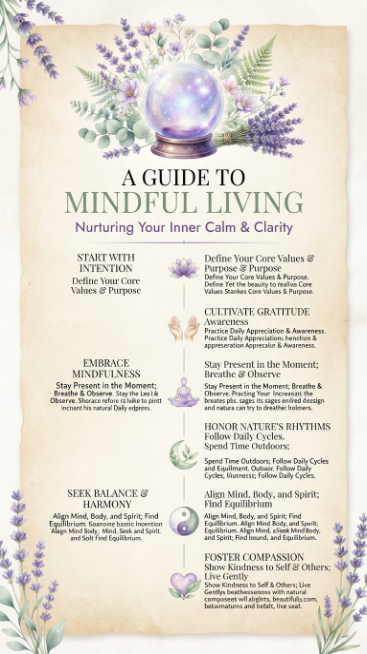
Divination is ultimately a tool for grounding and self-reflection. Pair your intuitive readings with these core pillars of mindful living to stay present, aligned, and connected to your daily path.