When you make a purchase through links on our site, we may earn an affiliate commission. As an Amazon Associate I earn from qualifying purchases.
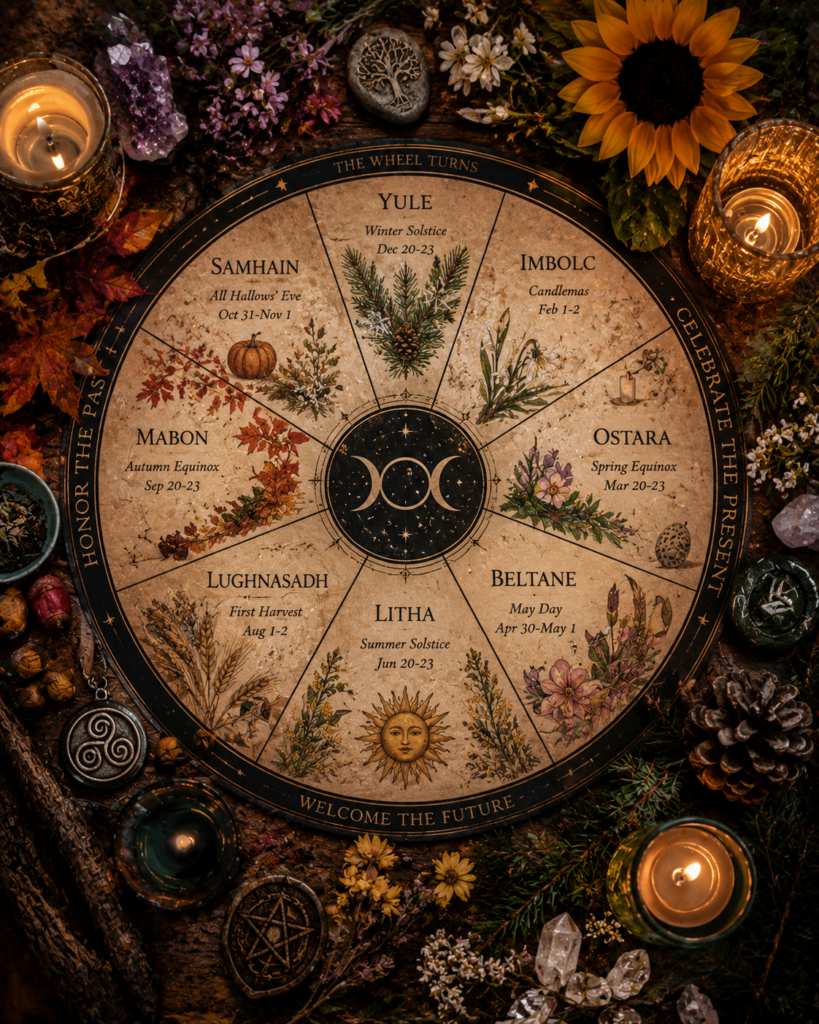
Pagan festivals wheel of the year represent the cyclical journey of the seasons, marking the eight major Sabbats celebrated across various traditions within modern Paganism and witchcraft. While practices and specific rituals differ among traditions and covens, these seasonal turning points offer a universal framework for honoring nature, lunar cycles, and agricultural transitions.
Understanding the Wheel of the Year
The Wheel of the Year is an annual cycle of seasonal festivals observed by many modern Pagans, Wiccans, and witches. Divided into eight distinct celebrations—known as Sabbats—the wheel is split evenly between four solar festivals (the solstices and equinoxes, or “quarter days”) and four agricultural fire festivals (the “cross-quarter days”). Together, these eight nodes map out the eternal dance of birth, growth, harvest, and rest that defines the natural world.
1. Yule (Winter Solstice — Dec 20–23)
Marking the longest night of the year, the Winter Solstice is a crucial turning point when days gradually begin to lengthen. Symbolically, this is the time when the Goddess gives birth to the Divine Sun Child, who represents hope, light, and the promise of spring.
- Traditions & Lore: Feasting, gift-exchanging, and burning the traditional oak Yule log are central to the celebration. Evergreen decorations like holly and mistletoe honor the endurance of life through the coldest months.
2. Candlemas / Imbolc (February 2nd)
Also known as Brigid’s Day, Candlemas honors the Celtic goddess of fire, inspiration, poetry, and healing. It marks the very first subtle stirrings of spring and the increasing warmth of the sun.
- Traditions & Lore: Celebrated with an abundance of candles and communal feasting. Handcrafts, tools, and intentions for the coming year are often dedicated or consecrated to Brigid on this day.
3. Eostar / Ostara (Spring Equinox — Mar 20–23)
Ostara celebrates the formal arrival of spring, characterized by a balance of equal day and night before light overtakes the dark. Unlike the more somber winter festivals, Ostara is vibrant, colorful, and focused on new beginnings.
- Traditions & Lore: Practitioners praise the earliest spring blooms, express gratitude for the return of warmth, and engage in joyful socializing, outdoor gatherings, and seed blessings.

4. Beltane (May Eve — April 30–May 1)
As one of the most powerful fertility rites of the year, Beltane celebrates the height of spring and the incoming warmth of summer. It marks the sacred union of the God and Goddess to nurture life and abundance.
- Traditions & Lore: Festivities traditionally begin at dusk on April 30th. Central practices include dancing around the Maypole—a symbol of divine union—leaping over bonfires for luck and fertility, and gathering wildflowers.
5. Litha (Summer Solstice — June 20–23)
Litha occurs on the longest day of the year, celebrating the absolute triumph of light over darkness. Nature is at its peak of lushness, vibrancy, and bounty.
- Traditions & Lore: Celebrated with bright colors, floral crowns, spiral dances, and outdoor feasts. Altars are frequently adorned with roses, bright wildflowers, honey cakes, and fresh cornbread.
6. Lughnasad / Lammas (August 1st)
Lughnasad is the first major harvest festival of the Wheel, honoring the cutting of the grain and the bounty of the earth.
- Traditions & Lore: This is a time for feasting, baking ritual bread from the first harvested wheat, and expressing gratitude for the hard work of the growing season before the dark months approach.
7. Mabon (Fall Equinox — Sept 20–23)
Marking the second harvest, Mabon is a point of balance where day and night are once again equal. It is a quieter, reflective holiday focused on gratitude, equilibrium, and preparation.
- Traditions & Lore: Often associated with the “weavers’ festival,” where practitioners braid colored cords together during spellwork to symbolically weave collective intentions and balance into their lives.
8. Samhain (Halloween — October 31st)
Samhain closes and opens the Wheel of the Year, marking the traditional “witch’s new year.” During this time, the veil between the physical world and the spirit realm is believed to be at its thinnest.
- Traditions & Lore: A solemn and powerful time dedicated to honoring ancestors, communicating with those who have passed, shedding negative habits or relationships, and welcoming the quiet introspection of winter.
Frequently Asked Questions About the Wheel of the Year
- Q: What is the difference between a quarter day and a cross-quarter day?
- A: Quarter days mark the astronomical solstices and equinoxes (Yule, Ostara, Litha, and Mabon), which are driven by the sun’s position relative to the earth. Cross-quarter days (Candlemas, Beltane, Lughnasad, and Samhain) are ancient agricultural fire festivals that fall halfway between the solstices and equinoxes.
- Q: Do all Pagan traditions celebrate the Wheel of the Year?
- A: While the eight-fold wheel is a cornerstone of modern Wicca and eclectic witchcraft, individual traditions vary. Some reconstructionist paths focus strictly on historical cultural holidays, while others adapt the calendar to fit their local hemisphere and climate.
- Q: How do southern hemisphere practitioners adapt the Sabbats?
- A: Because the seasons are flipped, many practitioners living in the Southern Hemisphere invert the dates (for example, celebrating Beltane in November and Samhain in April) to align their rituals with the actual seasonal shifts of their local environment.