
Magickal Correspondence Reference
Select an intention to view the traditional alignments.
When you make a purchase through links on our site, we may earn an affiliate commission. As an Amazon Associate I earn from qualifying purchases.
Historical Foundations of the Grimoire
The term grimoire originates from the Old French word grammaire, traditionally referencing books written in Latin. Historically, grimoires functioned as textbook-level instructional manuals for ceremonial magicians, clergy, and scholars throughout the medieval and Renaissance periods.
These texts were strictly objective, academic, and instructional. A traditional grimoire contains highly structured collections of:
- Astrological correspondences and planetary tables.
- Detailed lists of angelic or demonic entities, including their sigils and attributes.
- Specific instructions for compounding magical inks, cleansing tools, and casting defensive circles.
- Formal conjurations and complex ritual frameworks.
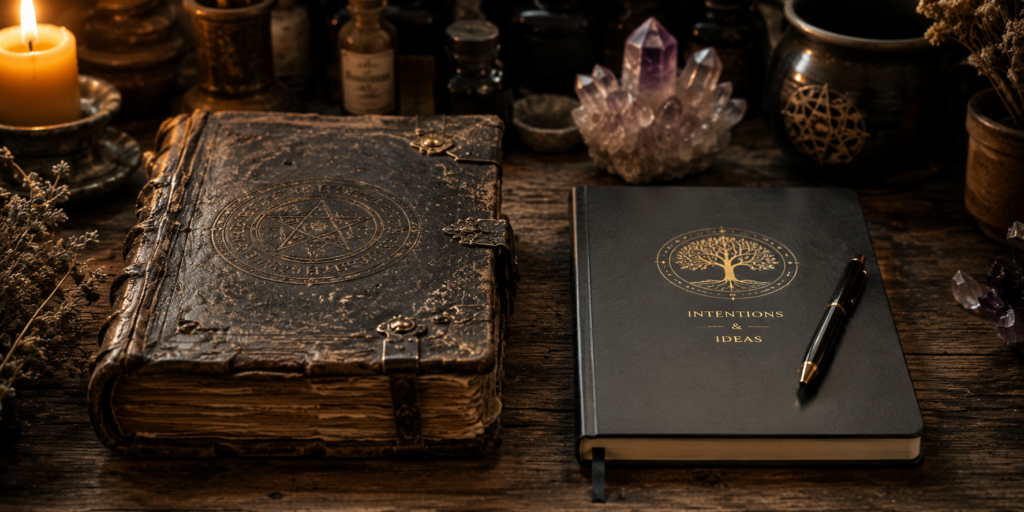
Notable historical examples include The Lesser Key of Solomon and the Grimorium Verbum. In these texts, personal insights or emotional reflections were completely absent; the books functioned strictly as authoritative, reproducible reference guides.
Evolution of the Book of Shadows
In contrast, the Book of Shadows is a modern development originating in the mid-20th century. The term was introduced by Gerald Gardner, the foundational figure of modern Wicca, who established the text as a core workbook for coven initiates.
Unlike the public or academic nature of historical grimoires, a Book of Shadows traditionally emphasizes privacy and personal evolution. Within modern traditional frameworks, it functions as a practitioner’s sacred workbook, containing:
- Specific rituals, core chants, and foundational laws of a particular tradition or coven.
- Personal dream logs, divinatory interpretations, and emotional reflections.
- Individualized recipes for herbal blends, oils, and candle practices.
- Records of successful workings and personal experimental outcomes.
Because it serves as a personal journal of spiritual progression, a Book of Shadows is traditionally treated as a private document, shielded from outside observers to maintain the integrity of the practitioner’s workspace.
If you want to clear mental noise before doing chart reads, try using a 2-minute sound ritual to center your focus.
When you don’t have 45 minutes for full ritual setups, working with ancient sound frequencies delivers rapid vibrational grounding.
Grimoire vs Book of Shadows: Side-by-Side Comparison
While modern practitioners frequently combine elements of both texts into a single working volume, understanding their core differences highlights their unique structural roles:
| Feature | Historical Grimoire | Modern Book of Shadows |
| Origin Period | Medieval and Renaissance eras. | Mid-20th century (Gardnerian Wicca). |
| Primary Tone | Objective, academic, and instructional. | Personal, reflective, and experiential. |
| Core Content | Sigils, planetary tables, and formal rites. | Coven laws, personal journals, and recipes. |
| Accessibility | Designed as an authoritative reference manual. | Treated as a private, sacred workbook. |
Modern Synthesis and Textual Integration
In contemporary solitary practices, the structural boundaries between these two books often blur. Many modern practitioners choose to maintain a dual-system approach to keep their workspaces organized. Under this method, a practitioner utilizes a formal grimoire to compile objective data—such as botanical profiles, mineral lists, and fixed lunar charts—while maintaining a separate Book of Shadows exclusively for personal records, active ritual results, and introspective journal entries. Ultimately, whether maintained separately or combined into a unified volume, these texts serve as indispensable anchors for organizing historical research and tracking personal development.
Frequently Asked Questions
Can I use a single notebook for both my grimoire and Book of Shadows? Yes. Many modern practitioners prefer a unified volume to keep all records accessible. Using a dual-section notebook or a binder system allows you to maintain the objective reference data of a grimoire in the front while reserving the back for personal entries and introspective journal entries.
Are grimoires only used for ceremonial magic? Historically, yes. Grimoires were primarily designed as instructional textbooks for formal ceremonial traditions, scholars, and clergy. In contemporary practice, the term is frequently used more broadly to describe any collected botanical profiles, crystal data, or candle practices used as a reference.
What should I include in my Book of Shadows? A Book of Shadows is intended to track your personal spiritual progression. It should contain your ritual results, dream logs, divinatory interpretations, and reflections on successful workings. It functions as a record of your individual path rather than a public manual.
Is there a specific way to start my first record book? There is no singular “right” way, as the best system is one you will actually use. Many practitioners start by documenting their first successful spell workings or setting up a reference section for common correspondences. The goal is to build a foundation that supports your ongoing research and development.